Grandbaby is scared of me! Now what?

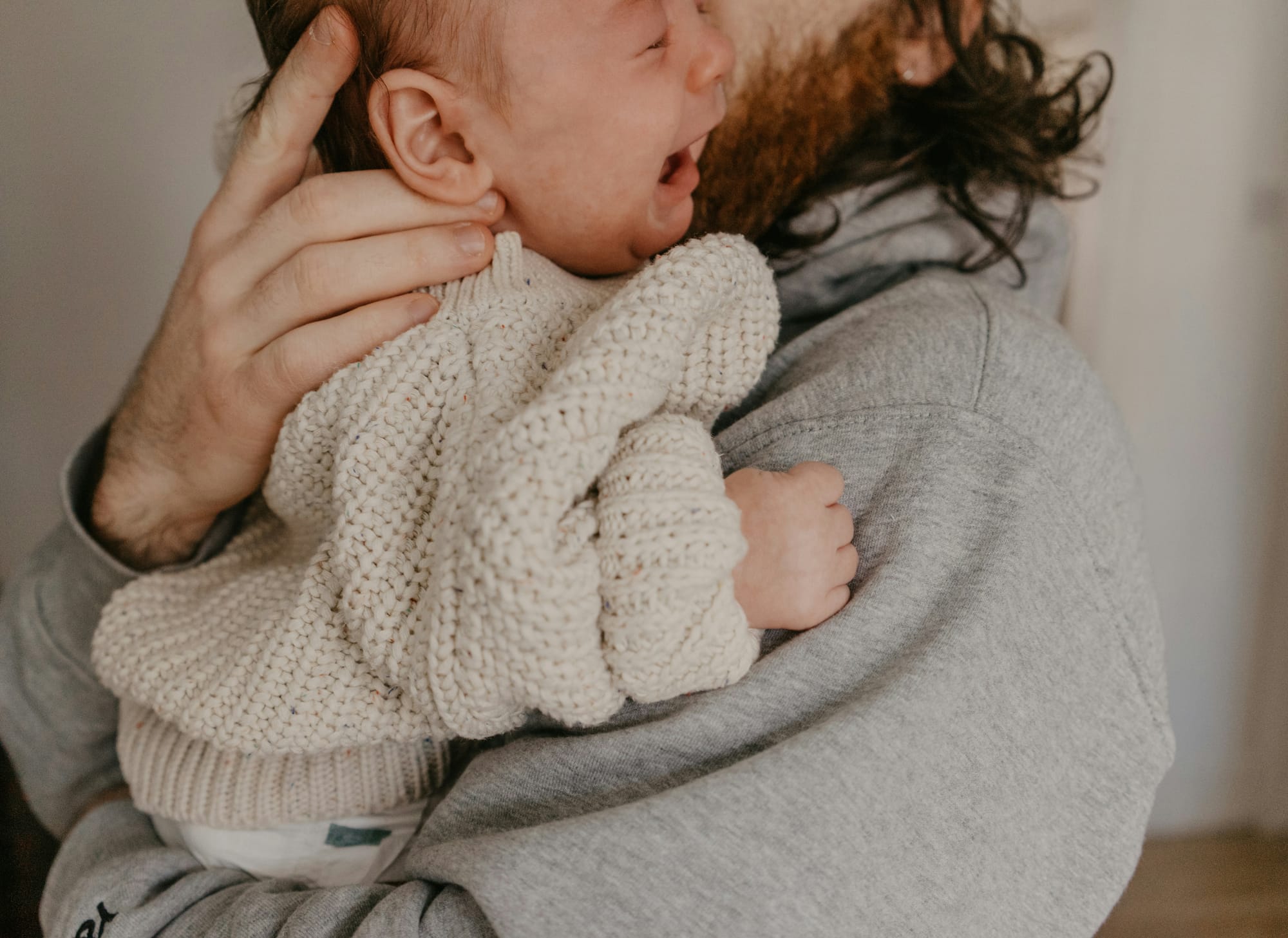
Four-month-old Baby granddaughter snuggled against me, beaming and chatting cheerily. Two weeks later, my holding her makes her utterly furious and maybe a little scared (or is it utterly scared and maybe a little furious?): She shrieks, sobs, and screams in my arms. I try singing, rocking, toys, interesting things to look at—nothing helps for more than a few seconds. Putting her down upsets her even more. I finally manage to get her to sleep in my arms, but when she wakens she looks at me shocked and wild-eyed, and resumes howling. The other grandparents are getting the same treatment, and we’ve considered and discarded other possibilities—hunger, illness, gas. Conclusion: Stranger anxiety has set in.
Stranger anxiety is a fear of unfamiliar or less familiar people that arises at ages four to six months after infants are able to consistently recognize their primary caregivers. It can come and go quickly, or last for months. Separation anxiety is a little different—it’s not the stranger that sets off the reaction, but the separation from the primary caregiver. Separation anxiety typically develops around 8 months. Either can be mild or intense, depending on the child and the situation.
Taking baby's fear seriously
Emotionally speaking, stranger anxiety is hard on everyone involved—baby, parent, and alternative caregivers like Grandma. Parents are likely to feel terrible in complicated ways about their child’s distress, and about leaving them: They might feel guilty, sad, fearful, remorseful, resentful (e.g., of having to work), or some complicated combination. The alternative caregiver, left with an inconsolable little one, may feel along with the parents, or may feel rejected, inadequate, useless, or frustrated. These adults can put Baby’s distress in context, however, while Baby can’t. Baby wants that special person now, and emphatically does not want substitutes or novelty. A baby with stranger anxiety is just figuring out that she is separate from her primary caregiver. She has probably not yet learned “object permanence”—that is, that objects (and people) continue to exist when they are out of sight. Even if she has, she doesn’t know whether object permanence is consistent. Baby has to put all that together: OK, Mama and I are two distinct people. Mama has gone away. Can she come back? Will she come back?? And unlike a toddler, who can be reassured with words like “Mama will be home soon,” Baby has to process her feelings without language. No explanations, no reassurances. No wonder she screams!
A quick survey (vs serious research) suggests that mainstream psychologists, pediatricians, and childcare advisors believe stranger anxiety is a normal developmental stage, and that the immediate distress you see does not do any long-term harm, assuming appropriate management of the stage (see box for the standard suggestions). Plus, even though 4-month-old babies in many other cultures/societies are spared separation from their primary caregivers, older babies, toddlers, or preschool-age children world-wide go through it at some point. And often these kids experience stranger anxiety’s cousin, separation anxiety, quite acutely. Not to mention the bottom line for parents: Practically speaking, the choice to leave Baby keeps her fed, clothed, and housed.
Still, I don’t see how we’d know that there’s no long-term harm from stranger anxiety—or separation anxiety, for that matter. (For an older [1998] and outlier view positing long-term harm, see endnote below.[1]) You’d need an extremely impractical (impossible?) experiment, given all the other influences you’d have to control for. And even in the moment, I think it’s important for parents and alternative caregivers—like us grandparents—to empathize with how terrifying stranger anxiety is for Baby. Consider how separation feels to adults: Remember elders dying from loneliness during Covid? Think of the pain of a break-up, a divorce, or a death. Or how it feels to long for someone far away. The displacement and grief of these experiences are “normal,” psychologists and doctors assure us. But such normal aches fill our hearts, and literature, and songs—even though we can explain the absence or loss to ourselves, and even when we can reassure ourselves that the loss or separation is temporary. And there are times when a childcare situation is not working.[2] All of this means that despite the fact that stranger anxiety is normal, it also needs to be taken seriously and managed gently.
There’s also a political aspect to the discussion: The main reason families in the US confront this issue in very young babies is that we have poor support for young families. In principal, at least, US parents have a right to 12 weeks of unpaid maternity leave. But even if you’re lucky enough to live in one of the minority of states requiring paid leave for 12 weeks, you still only get a scant 3 months of at-home time with Baby. In contrast, most countries in Europe, along with Russia, India, Japan, New Zealand, and Canada, offer 24 weeks or more of paid leave after childbirth; many also allow additional time off unpaid. Among the higher-income countries, then, figuring out what to do for a 4-month-old with stranger anxiety is mostly a US problem.[3]

Helping ease baby's fears
OK, then: Grandparent, parent, and baby need to figure out how to ease stranger anxiety. Here are the standard US solutions to this US problem, found in various formulations on dozens of internet sites (this one from a commercial site, Huckleberry Labs):
Tip | What it means | Why it helps |
Ease into new caregivers or settings | Start with short, supported separations and gradually build up time away. | Gives your baby time to build trust and learn that they can cope without you. |
Project calm confidence | Use a relaxed tone, steady movements, and reassuring body language at times of separation. | Babies pick up on your emotions — confidence helps them feel safe. |
Always say goodbye (and be specific) | Let your baby know you’re leaving and when you’ll return in simple terms. | Builds trust and helps your child practice healthy separations. |
Keep goodbyes brief | Offer comfort, say goodbye clearly, then leave without lingering. | Long goodbyes can increase distress rather than ease it. |
Create a consistent goodbye ritual | Use the same words, gestures, or comfort object each time you leave. | Predictability reassures your baby and supports emotional regulation. |
Good start! Our recent experience suggests that these approaches do help. But wait…most of that is advice for the parent who is leaving the child. What about advice for the person—like Grandma—who is left with an inconsolable baby??
Here are a few ideas we’ve been trying, and that (so far) seem to be easing the distress.
• Our taking care of Baby is not new. We have been caring for her without parents, or with parents nearby but working, from the time she was a newborn. So she does know us. Baby’s parents have devoted lot of effort to making sure this is true for us and for the other grandparents, who also provide care.
• Baby’s parents have the good fortune of having flexible schedules, so they can minimize the time Baby needs to be away from them—not a luxury every parent has.
• After managing the transition as per the standard advice, we try to stay ahead of Baby’s needs, so she doesn’t get upset about being hungry, tired, or bored. For example, if she seems to be getting tired, we get her diaper changed and get ready to take a stroller ride (which puts her to sleep) before she gets seriously cranky.
• For the caregiver, one point of the standard advice deserves emphasis: Anxiety is contagious. As hard as it is to care for a baby who is upset, the best thing to do is to stay calm. Otherwise, you and baby can create a feedback loop, heightening each other’s stress.
• Know what works to soothe your grandchild, and do more of that. Ours loves stroller rides. So caring for her these days gets us a lot of exercise!
• I’ll mention the possibility of distraction, although our granddaughter has not been distractible from her stranger anxiety once she gets upset. You, however, might succeed with with singing, baby games, fun things to look at or touch, or toys.
• I’ll also mention the possibility of a lovey or transitional object, with the caveat that having one doesn’t seem to help our granddaughter much—apparently a lot of babies find it helpful, though. If you try it, please remember that the suggestions/requirements for use include having identical backups, having the lovey smell like the primary caregiver, and not having it in bed until the child is 12 months old.
All that said, all we can do is collectively keep our fingers crossed—and hope that this is a stage Baby negotiates quickly!
Endnotes
1. Amidst a near-uniform sea of agreement in online and standard childcare books that leaving babies with stranger anxiety behind for work or other activities is harmless, despite the crying, I found one 1998 article that questioned this practice and others, like sleep training that leaves baby to cry it out, and speculates the following: “One implication is that cultures that train for independence, and therefore self-responsibility, risk having more PTSD later in life. That is because these cultures do not support infants (nor adults) during stressful and traumatic events to the same extent as do cultures that emphasize dependence and mutual support. Whether distressed or not, individuals are isolated or separated and do not experience as much physical contact, which is known to be soothing (it has been shown to reduce blood pressure and so on). Early stressful practices may produce lasting effects, as these areas of the brain are still developing. As has been suggested by numerous investigators, the pathways that remain in place after early development are very determined by experience (as summarized in Todd et al., 1995). There may therefore be permanent alterations in stress-related neurotransmitter systems (such as the release of higher levels of cortisol).”
2. A large pediatric practice notes on its website, “Also, trust your instincts. If your child refuses to go to a certain babysitter or daycare center or shows other signs of tensions, such as trouble sleeping or loss of appetite, there could be a problem with the childcare situation.”
3. It’s an interesting question whether the standard advice and reassurance are influenced by the political climate. I’m asking, but I don’t know the answer.