Helping a vulnerable child

In a previous post, I said I would come back to talking about how grandparents can help their grandchildren manage vulnerability. Thanks to psychologist Anne Williams-Wengerd, MA, LP, PhD, a friend and former collaborator (see here and here) I’m making good on that promise now.
What grandparents can offer
Williams-Wengerd's eclectic approach to practice emphasizes the practicality of cognitive behavioral therapy and the emotional richness of attachment theory. In her estimation, grandparents have a lot to offer when it comes to recognizing children’s vulnerability and helping them manage it. “Grandparents have more years on this earth, more experiences. They’re at a time in their life where developmentally speaking, they are probably reflecting back on what they've learned and oftentimes more aware of their own vulnerability.”
Grandparents are also in a position to reflect broadly on changes in society and parenting/grandparenting over time. For the boomers who are most of today’s grandparents in the US, she suggest this means observing that we were, “in a place that was still very much a patriarchal world and all about productivity and efficiency, and that relationships don't work well in that paradigm.” (Insert thoughts about your own parenting here—I remember a cringe-worthy focus on achievement in our house!)
All of which gives grandparents a chance to flip the script, starting from, “Yeah, I can see how that hasn't really worked great,” and going to a place where you realize that “you’re not going to harm [your grandchildren] with too much warmth.”
In this way of thinking, vulnerability isn’t negative—it’s part of being human. Vulnerability is the openness that lets us connect with others to develop any kind of relationship: parent-child, grandparent-grandchild, partner-partner, therapist-client. It’s also an openness to experience. But of course, relationships and experiences can go wrong, so vulnerability is scary. And that fearful part of vulnerability is what we grandparents can help grandchildren with. Says Williams-Wengerd, “As caregivers, we get to hold that for them: ‘It's so scary. Guess what?...We're gonna help you with that. It's gonna be okay.’”
What do to in the moment
So how do we help? The basis is co-regulation of emotion: The caregiver acts as a container for the strong feelings, and helps the child recognize them, put them in context, calm them, and—over time—learn to do this themselves. How this works depends on what is upsetting the child.
Bucking limits: Families need a balance of warmth and structure, says Williams-Wengerd, who is a family clinician in a multidisciplinary early psychosis treatment program at the University of Minnesota. Having (reasonable) limits for children is part of the structure. (Like limits on sweets, screen time, jumping on furniture, etc.) The warmth comes in helping them deal with their frustration at the imposed limit. She suggests being open to hearing what the grandchild has to say and hearing what they're offering as an alternative. To do this honestly means creating space for the child’s emotion, perhaps sitting down with them for a discussion (not a lecture!). It also means being vulnerable enough yourself that there’s a chance they’ll convince you that your limit is too strict.
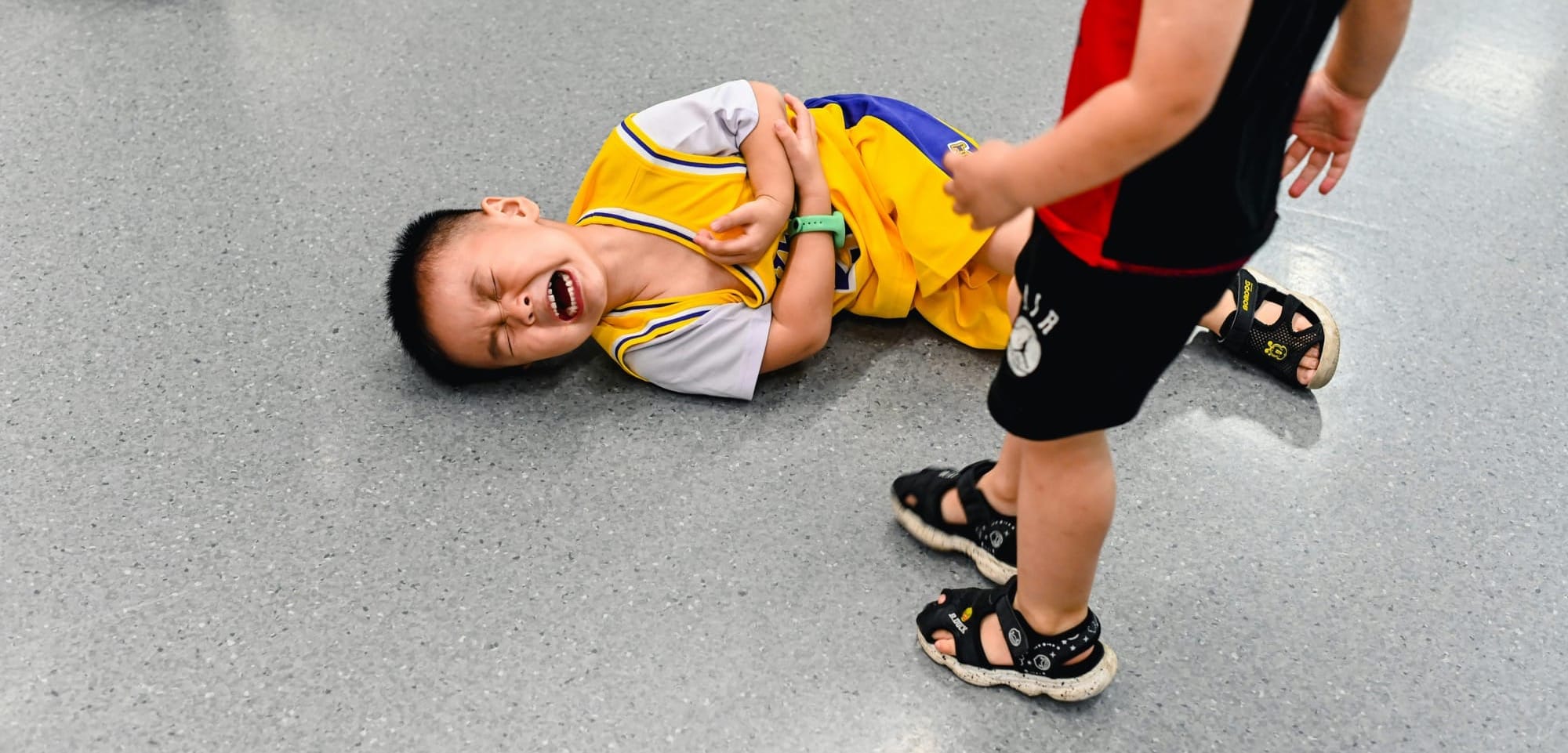
Falls and other injuries: When the child is injured, says Williams-Wengerd, what “the caregiver can provide is something for the child to tether onto that can help them co-regulate.” You help the child narrate the story of their injury: “‘Oh, I know, that was so scary. Oh, my goodness. Oh my…that just happened so fast, and you didn't even know what happened. I'm with you. It's okay. You're okay.’” Words like this, said with hugs, holding, and gentleness (as befits your relationship with your grandchild) can gradually help the child calm down, and—over time—learn to self-calm in similar situations. For some grandparents, this approach requires a shift in thinking. You may have been raised to think that if you cried after a fall you were “acting like a baby.” With this attitude, children were left on their own to figure out how to manage their emotions. The gentler approach advocated by Williams-Wengerd instead has the adult standing by the child to teach them how to manage the emotions.
Separation anxiety: If your grandchild experiences separation anxiety—for example, when a parent leaves, or when you do—you’ll need to check in with the child’s parents about the right approach. Williams-Wengerd’s advice for both parents and grandparents, though, is to help the child get to a point that they can trust that the person who left is coming back. This means that the role of the person left caring for the child is to provide secure base: Helping narrate and calm, establishing that you are there for them now, all the while empathizing with the child that indeed it is scary when their parent leaves, checking in about how you can help them right now, and reassuring that the parent will come back. “Plus a lot of positive reinforcement of when they [succeed]: ‘Oh, I saw you. You did such a good job when he left for five minutes!’”
Really hard times: In very difficult situations—such as abuse of a child or death of a parent—none of the child’s caregivers may be able to help the vulnerable child enough, says Williams-Wengerd, because they themselves are “…really struggling. So maybe they can't provide that level of co-regulation that the child needs because there's too much to hold.” If this is the case, a professional counselor may be needed to help the child or the whole family.
Recognizing that a child is feeling vulnerable
To be a co-regulator or container for the child’s emotions, grandparents have to first be aware that the child is feeling vulnerable. Because the ways children (babies through teens) show vulnerability depends on age, situation, and temperament—and varies tremendously—recognizing their vulnerability may not be easy.
Two basic patterns to look for, says Williams-Wengerd, are internalizing and externalizing of emotion. Internalizers withdraw, shut down, try to deal with strong emotions by themselves. Externalizers have tantrums, yell, refuse to do what adults want of them, or fight—maybe with adults. If a child is acting in either way, it’s a sign of emotional dysregulation. And that dysregulation, she says, can be a sign of the child feeling vulnerable, and/or can make the child feel vulnerable, because they know that they are not acting according to expectations. Or, to put it in a way that helps see what the adult role is, the child is acting in ways that trouble the adults around them because they “haven’t developed the coping mechanisms” that let them manage the dysregulation on their own.
In either case, a grandparent who has a close relationship with a grandchild may be able to help. With the externalizers, recognizing tantrums, etc., as dysregulation—vs, say, naughtiness or willfulness—can show a way toward calming a situation with your own calm, or possibly with humor or distraction. With the internalizers, recognizing withdrawal, etc., as dysregulation—vs, say, rejection—gives you a chance to be a secure base the child can return to, even if they push you away sometimes.

Recognizing your own dysregulation
Another required element for helping a vulnerable child is potent self-awareness, says Williams-Wengerd, “Because a dysregulated adult can never help a child regulate…If you're dysregulated, they don't have anything to tether to.” She explains that we are at our best when we are moderately aroused—alert, attending to our surroundings, thinking clearly. If we’re hypo-aroused, we’re in shut-down mode, without the capacity to reach out to be there for the child. If we’re hyper-aroused, “Our heart rate is up, we're talking rapidly, we're yelling, we're acting out of that part of our brain that acts really fast.” This state is great if you’re in emergency mode—say, a child runs into the street—but otherwise it means you’re too agitated to be that container, co-regulator, or steady presence for a vulnerable child.
Working with the parents’ styles
Williams-Wengerd works with families to help them recognize and achieve a working balance of warmth and structure within the family relationship. Perhaps Mom is more into warmth, Dad into structure, or vice-versa. But the balance is a complicated, multi-generational, dynamic dance. How did you (the grandparent-reader) parent your now-adult child? Maybe you were warm and indulgent—your child could do no wrong. Or maybe you emphasized structure and predictability, and were mostly not emotionally present. How did your style impact the way your child parents now? Are they embracing your style or rejecting it? How does all this affect your adult relationship with your adult child?
Perhaps whatever pattern you have is working for your family. Perhaps it’s the best you can do, given your own limitations and limitations of circumstance. Or, with the benefit of hindsight, says Williams-Wengerd, you might see a pattern repeating that you regret, and shift your approach, deciding, “‘No, I'm going to do it differently; I'm going to be more [or less] vulnerable than I was when I parented my child.’” You can then model the change, “…which may or may not influence your child’s parenting, but it will no doubt influence your grandchild.”
Whether your approach to your grandchild’s vulnerability is status quo within your family, or a shift to a new balance for the family or for you personally, Williams-Wengerd cautions that you not assume you know the parents’ attitudes. Take cues from the parents’ styles, and have a conversation with them about what you can do to work with your grandchild. Even if you aren’t a regular caregiver for your grandchild—like most grandparents these days—such openness can give you guidance as you build a relationship with the grandchild, and it can go a long way toward providing a degree of consistency and a stable base for the child.
Earning the right
Importantly, Williams-Wengerd offers a caveat in thinking about your own interactions with your grandchild: Consider that degree of attachment and relationship you have with the child. Just as in any relationship, responding to another’s vulnerability may be a way to build relationship and rapport, but you also have to have a relationship already for someone to be willing to accept your responsiveness. So, she says, your investing in the relationship over time comes before you earn the ability—or the right—to be there for the child.
Wherever you are in developing your relationships, thinking, and skills for helping grandchildren manage vulnerability, Williams-Wengerd says, “Lead with your heart. Think, ‘I’m going to come alongside you, little one, and be there for you and have an authentic relationship with you.’” “And,” she adds, “Don’t be afraid of your own vulnerability…” as the relationship blooms.
Philosopher Grandma Readers: Do Anne Williams-Wengerd’s ideas of “being a container” for a child’s strong emotions, or helping them co-regulate their emotions, give you ideas for supporting a vulnerable child in your life? I’d love to hear your ideas in the comments!