Taming phone addiction: Do it for the grandkids!

How do I know I’m addicted to my phone? The signs that bother me the most are the ones that show up around the grandkids. I’m holding Baby as she naps, and rather than reading a paperback—or heck, just enjoying her—I do puzzles or read on my phone. I’m with a grandchild, and can’t help checking for emails or texts or (worse) the Trump Headline du Jour. The grandkids are doing something, and my first thought is photo or video. Or if they are happily engaged, I’ll sneak off to see what’s happening on my phone. (Just to reassure The Parents, these phone moments are brief! But the pull and the distraction are real.)
Then there are signs when I’m on my own, too. I do a LOT of New York Times puzzles. I doomscroll. And obsessively keep my place in the Diamond League in Duolingo, while not learning much Spanish. On the other hand, I’m not TERRIBLY far gone! I like being outside without the damn thing. And so far I haven’t wandered onto my phone during a sermon, despite being sorely tempted. And except for doomscrolling, my phone activities do have some value…but the devotion to the device does mean that I’m thoughtlessly giving up time I could use to read books, or write, or listen to music, or meditate, or pray, or watch the birds, or…

"'Addiction'? Come on!"
At the same time I’m noticing my own behavior, I’m reading a lot about negative effects of phone use for children’s social, intellectual, and even physical development. Detailing those negative effects—and the occasional positive one—needs another post. For now, suffice it to say that phones are even more addictivefor kids and teens than they are for adults. So I’m increasingly realizing that in addition to curtailing my phone use for my own sake, it’s also my job as a grandparent to avoid tempting the grandchildren.
I say “increasingly” because phone addiction has snuck up on me. Fifteen years ago, I just used my first smartphone to communicate. I read and answered student emails on the bus, and chatted with family and friends. Then I got used to web searching, and added news apps and music. I jettisoned my watch and calculator and paper calendar. I did less and less in-person shopping. I onboarded language learning, apps for my hobbies, those New York Times puzzles, and lots more news apps. (Never social media apps—I knew how bad that would be!) Even so, my life—my functioning, my mind—has now become so intertwined with the phone that I feel incomplete and anxious without it.
But wait—a lot of what I do with my phone can be recast as an advantage. The efficiency of having all that in one place! The connectivity with our adult children, who love getting photos of their kids having fun—and who want to weigh in on whether a kid’s cut or rash needs medical attention. The priceless memories contained in those photos and videos. And, more consequentially, staying informed of ICE activity and opportunities to aid or resist. Not to mention ways the grandkids and I use the phone—timing their sprints, managing sharing intervals (Kid 1 gets 5 minutes, then Kid 2 gets 5 minutes), looking up answers to questions, and working those New York Times puzzles with Eldest Grandchild.
With all those positives, why refer to heavy, or even compulsive, phone use as an “addiction,” given the negative connotations of that term? The reason is that saying something is an addiction doesn’t just mean you do or use the phone/drug/cigarette/slot machine/whatever a lot: It means that doing or using that thing has bad consequences for your life or others’ lives. And that you keep doing it, despite the bad consequences. For example, maybe someone spends a lot of time working out. Necessarily, the long sessions mean there are other things they can’t do. But as long as the person has time for other core needs of their life, like work and relationships, the exercise is healthy and time well-spent. But exercise can be overdone—it can become so consuming that work and relationships suffer, and the exerciser’s body becomes fatigued and injury-prone. If at that point she doesn’t lighten up, her exercise pattern has crossed into addiction. The familiar pattern of alcohol addiction is similar. Light drinking even daily might not cause discernible problems or risks. But as drinking frequency and quantity increase, use can fade into addiction/alcoholism, when the negative health, work, or relationship effects become clear, and stopping the alcohol use is very hard.
So when I say I have “phone addiction,” I mean that the way I use the phone has negative consequences for my life or someone else’s, and that I can’t easily stop my behavior. All those signs I listed in the first couple of paragraphs—distraction from the grandchildren, anxiety from doomscrolling, time spent on trivial activities—are negative consequences that I notice fairly readily. Then there are the subliminal harms. People’s—my!—cognitive capacity goes down when my phone is nearby even if it is not on. If the phone is around and on, and I’m trying to attend to a lecture, instructions, a Zoom meeting, or a book, my attention and memory for what I am trying to learn will decline. And is it hard to quit? You bet. Just looking at that bright red iPhone makes me want to jump on to see who has contacted me, what’s happening in the news, or how fast I can solve Pips. And once on, one thing leads to another…
So phone use is potentially—and very commonly—addictive. In addition, phone addiction is contagious, with potential to infect the grandchildren. By design, phones magnetically attract their attention, distracting them from whatever they are doing. Get your phone out, and the grandkids will pull away from interacting with you, with each other, or playing at the park in order to interact with the phone. This pattern repeats over and over, because the phone is with you all the time (museum, beach, kitchen, you name it!) and because it gets pulled out frequently (a text message! What time is it? Do I need to wear a scarf? I need a video! What was that guy’s name, anyway?). Plus, by age 2 or 3 they’ll be able to use the phone independently, and (believe me!) by age 5 or 6, they’ll figure out your passcode. So—back to the communicable disease metaphor—the more you pull out your phone, the more having a phone in your life and the grandkids’ lives gets reinforced, and the more the kids get interested in having their hands, eyes, hearts, and brains intertwined with the device. So they get infected, although their disorder won’t be full blown until they have their own device.
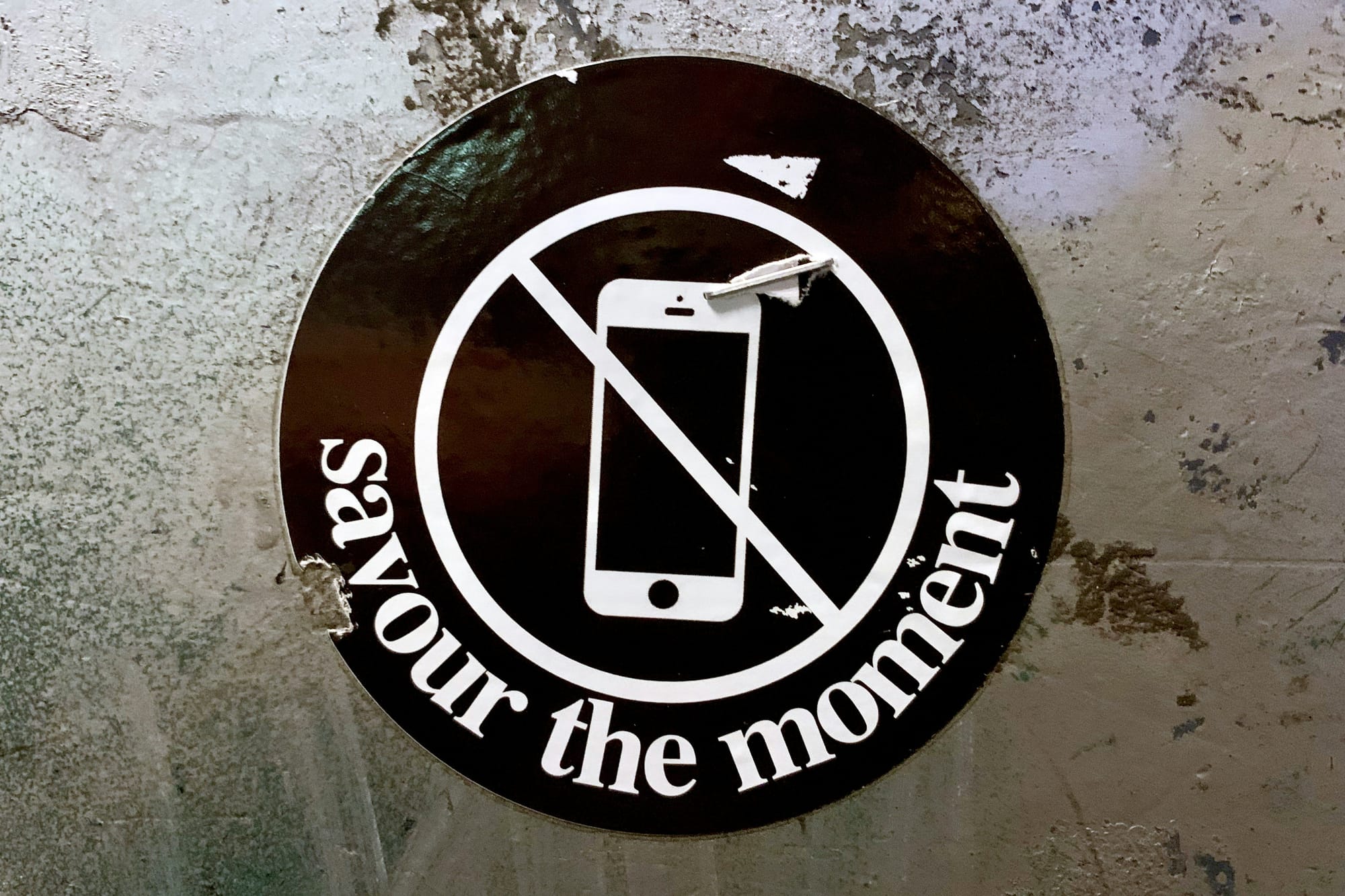
Upshot: A phone fast
So! My phone use has become a problem for me and for the grandchildren. This epiphany happens to have coincided with the beginning of Lent. So my Lenten discipline this year is to rein in my phone use, motivating myself with memories of the before-phone times when I could focus better and had more time for reading and other intentional activities. And of course, by wanting to do better by the grandchildren.
I can’t just quit using the phone. (A 6-year-old grandson thought otherwise. “Just put it in the trash!,” he said. Direct, effective, but, sadly, impractical.) But here’s how I’m limiting temptations to look at the darn thing:
· To avoid visual triggers, I put the phone on a shelf when I’m not using it.
· I’m wearing a watch that doubles as an alarm clock.
· I’ve scaled way back on phone activities: For example, yes to one Duolingo session per day, no to New York Times puzzles. (And taking physical reading materials for waiting times.)
· I’m checking emails and texts at designated times, rather than whenever/frequently.
· I’m reading news on my computer instead of on my phone. And then only in the same timeframe as the email/text checks.
· Most important: When I’m around the grandkids, I put the phone away.
I’m hoping the changes will be lasting…so far, six days in, I’m seeing only upside. In particular, I think cloistering the phone will be good for my relationships with the grandkids and for my influence on them. Still, 40 days is a long time—so in a newsletter around Easter, I’ll let you know how it went!